

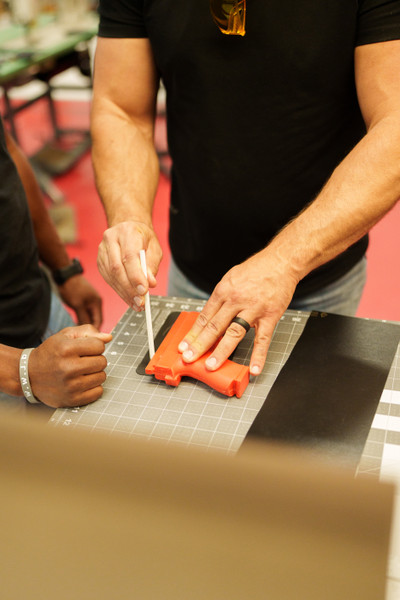
Why your holster deserves more than a one-size-fits-all approach.
Custom fit is on a lot of holster listings now, right next to universal fit, made to order, and molded for your model. If you read enough product pages, they all start to blur together. That matters more than it seems.
A concealed carry holster is something you may wear for twelve hours a day, whether you are sitting, driving, standing, or drawing from it. When the fit is wrong, you feel it, and an uncomfortable holster tends to end up in a drawer.
So before you trust the “custom fit holster” label, ask a simpler question: custom fit to what?
What Does “Custom Fit” Actually Mean?
The phrase gets used for at least four different things. All of them are legitimate, but they aren’t interchangeable.
Universal-Fit Holsters
These accept a range of similarly sized pistols, usually with soft materials, straps, or a generic pocket shape. The appeal is flexibility. The trade-off is that how securely it holds, and how well it covers the trigger guard, can vary from one handgun to the next.
Model-Specific Holsters
These are shaped around one particular make and model, like a Glock 19, a SIG P365, or an M&P Shield Plus. With Kydex, that usually means heat-forming the shell around the pistol’s contours so it fits that model closely.
Made-to-Order Holsters
This describes when a holster is built. A made-to-order holster is built after you order it, to the configuration you selected, rather than coming off a shelf.
Personalized Features
Handedness, cant, ride height, clip style, sweat shield, light compatibility. These are choices layered on top of the basic fit.
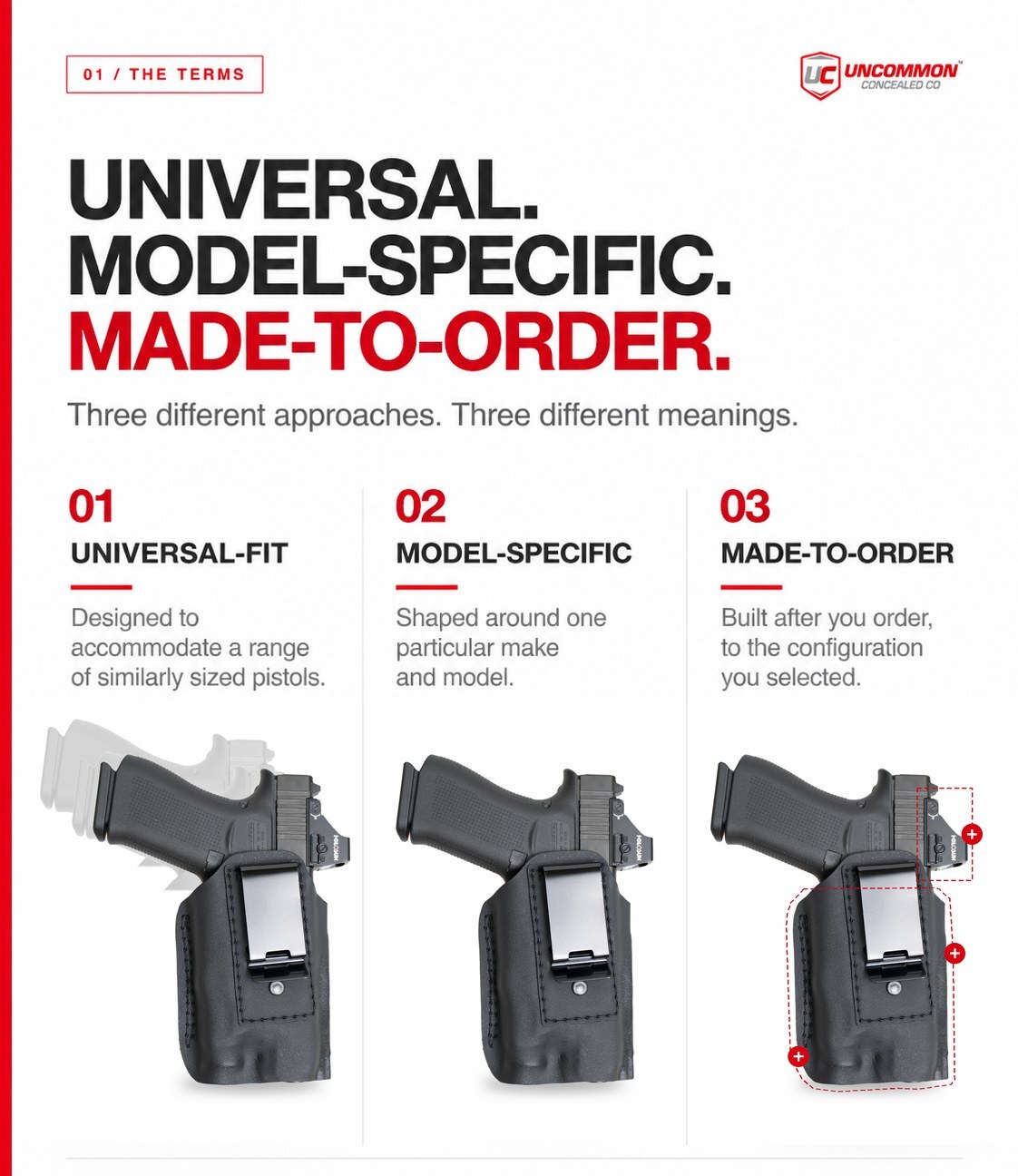
Universal, model-specific and made-to-order describe three different things.
“Custom fit” doesn’t have to mean every component was handcrafted just for you. A well-made custom Kydex holster often pairs a shell molded to your exact model with standard clips and screws. That’s normal. What matters is knowing which parts are tailored to you.
Why Model-Specific Fit Matters
Two pistols that look about the same size can differ in ways a holster has to account for: slide width, trigger-guard shape and position, the dust cover and rail, sight height, and whether there’s an optic or light mounted. Three important things depend on getting those details right:
- Holster retention. In a molded Kydex holster, retention usually comes from the shell itself, often where it closes around the trigger guard, rather than from a strap or button. A close fit to your model is what makes that retention consistent.
- Trigger-guard coverage. A holster should fully cover the trigger guard. A shell formed to the exact model is one of the most dependable ways to get there.
- Accessory compatibility. A mounted light changes the whole front half of the pistol’s profile. A holster made for the bare pistol won’t accept one, and a holster made for one light may not accept another. Optics and taller sights raise similar questions.
No holster makes carrying safe by itself. Good fit supports safe carry. It doesn’t replace training, careful handling, and regular practice.
Your Pistol Isn’t the Only Thing That Needs to Fit
A holster can match your pistol exactly and still be wrong for you. It’s only one piece of a complete carry setup. Here are other considerations:
- Carry position. Appendix (AIWB), strong-side IWB, OWB, pocket, and off-body.
- Clothing. An untucked tee, a tucked button-down, and a winter jacket all conceal differently.
- Body type. Torso length, waistline, and how you sit all affect where a holster rides.
- Daily activities. Long drives, desk work, and physical jobs make different demands.
- Your belt. A sturdy carry belt does a lot of the work.
That’s why many experienced carriers own more than one holster. Choosing the right holster is less about finding the single best design and more about matching one to how you actually live.
Customization Should Be Functional, Not Just Cosmetic
Colors and finishes are fine. But the customization that changes how a holster carries is functional:
- Cant. A zero-cant holster rides straight up and down. A forward cant, like the common 14° “FBI cant,” tilts the grip, which can change both concealment and wrist angle depending on where you wear it.
- Ride height. A higher grip is easier to get your hand on but can print more. A lower grip conceals well but can make a full firing grip harder to establish. Some clips let you adjust this. Spring clips, adjustable clips, and belt loops each behave differently on the belt. Our standard for IWB holsters is for them to ride as low as possible while still allowing a full combat grip.
- Concealment features. A claw or wing uses belt pressure to rotate the grip toward your body. You’ll see this most often on appendix holsters.
- Comfort features. A sweat shield adds a layer between the pistol and your body.
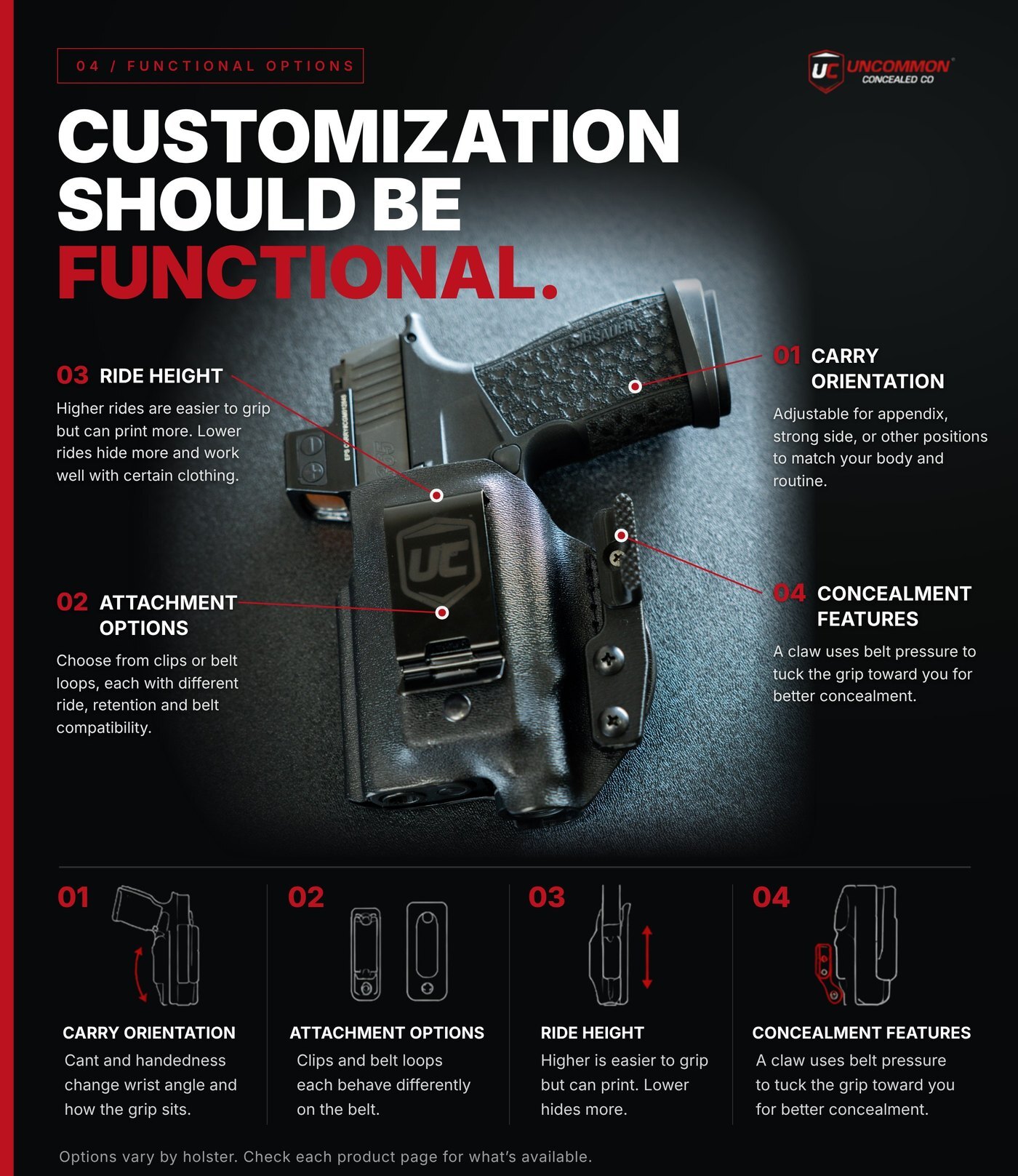
The options that change how a holster carries: orientation, attachment, ride height and concealment.
If a “custom” option doesn’t change how a holster fits, carries, or draws, it’s an aesthetic choice. Nothing wrong with that, but it isn’t what makes a holster fit.
Questions to Ask Before Buying a Custom Fit Holster
- Is it built for my exact model and configuration?
- Are my accessories compatible?
- How is retention achieved, and what’s the standard?
- What carry positions is it designed for?
- What attachment options are available?
- What should I know about ordering?
The Uncommon Concealed Approach
Our holsters are built to order in our Gilbert, Arizona shop. We use ultra-thin .040″ Kydex for all inside-the-waistband (IWB) and pocket holsters, and .060″ Kydex for outside-the-waistband (OWB) holsters. Each holster is individually molded to fit the specific pistol and configuration you select when ordering.
When you order, we ask for your exact model, right- or left-hand carry, whether you run a mounted light (chosen from the lights listed on the product page), and whether you want a sweat shield. The lineup covers appendix, IWB, OWB, tuckable, pocket, purse, and off-body carry, with cant options that include zero, 7°, 14°, 20°, and cross-draw.
Two Examples From Uncommon Concealed
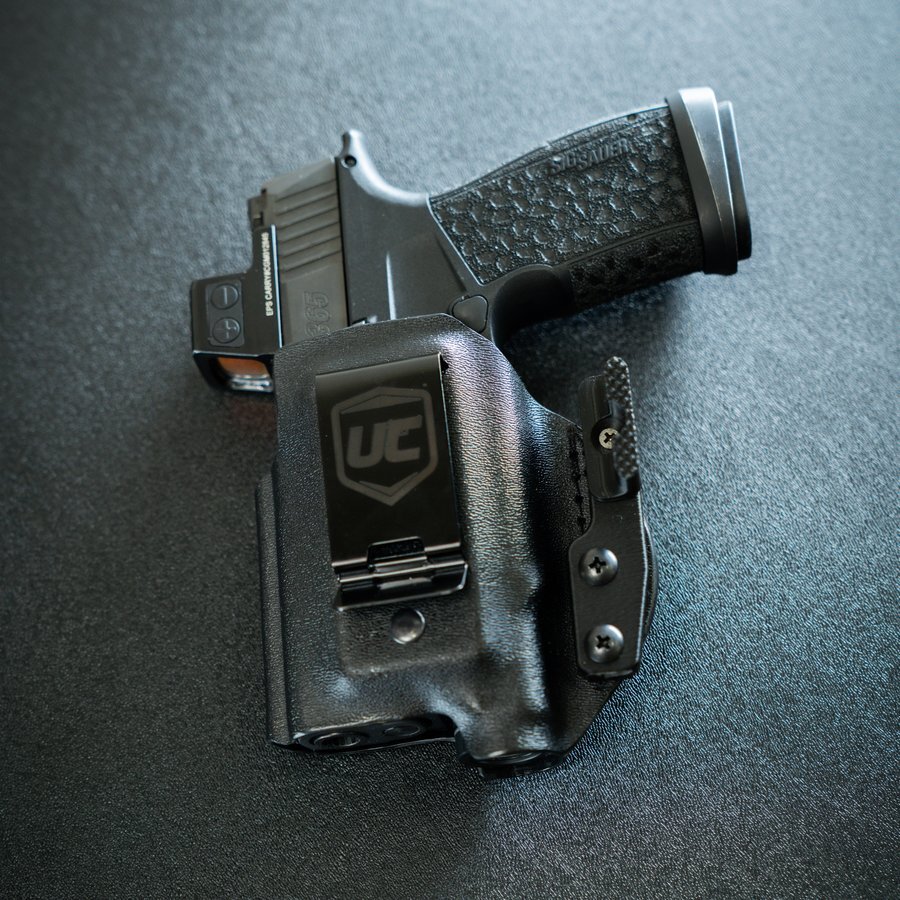
UC AIWB
Appendix carry with concealment claw
The UC AIWB is built for vertical appendix carry. It has a concealment claw that helps pull the grip toward your body, plus a metal spring clip for belts up to 1¾″.
View Product →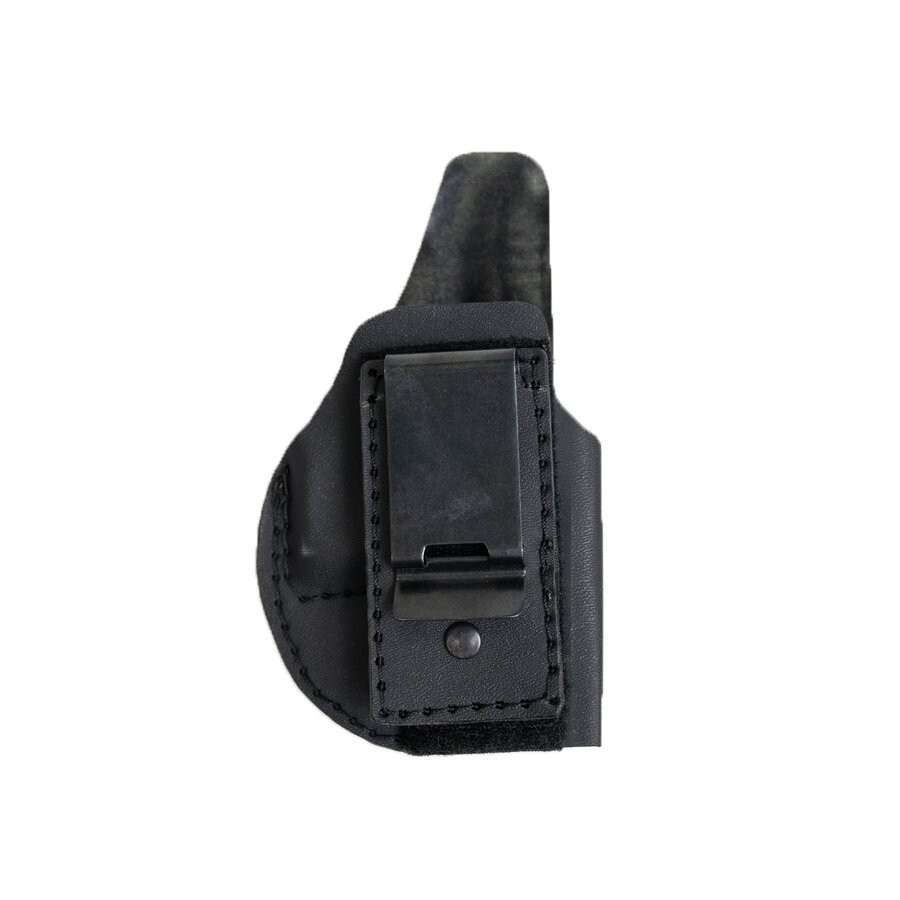
UC IWB with Adjustable Velcro Clip
Zero-cant, adjustable ride height
The UC IWB with Adjustable Velcro Clip is a zero-cant, straight-draw design whose clip lets you set your own ride height, for belts up to 1¾″.
View Product →We’re also direct about retention. Our standard is that an unloaded pistol should stay securely seated during normal movement and when the holster is held upside down, while still allowing a smooth, consistent draw. That standard is built for everyday carry. If you need duty-level retention, a different design may serve you better, and any maker should be willing to say so.
Custom Fit Should Be More Than a Label
A genuinely custom fit holster is shaped to your exact model and configuration, matched to how and where you carry, and set up with features that change how it performs. It comes from a maker who can clearly explain what’s tailored and what isn’t.
If you’re working through those questions now, our holster selection guide and FAQs are good places to start. When you’re ready, you can browse the full holster collection and build one around the way you carry.